
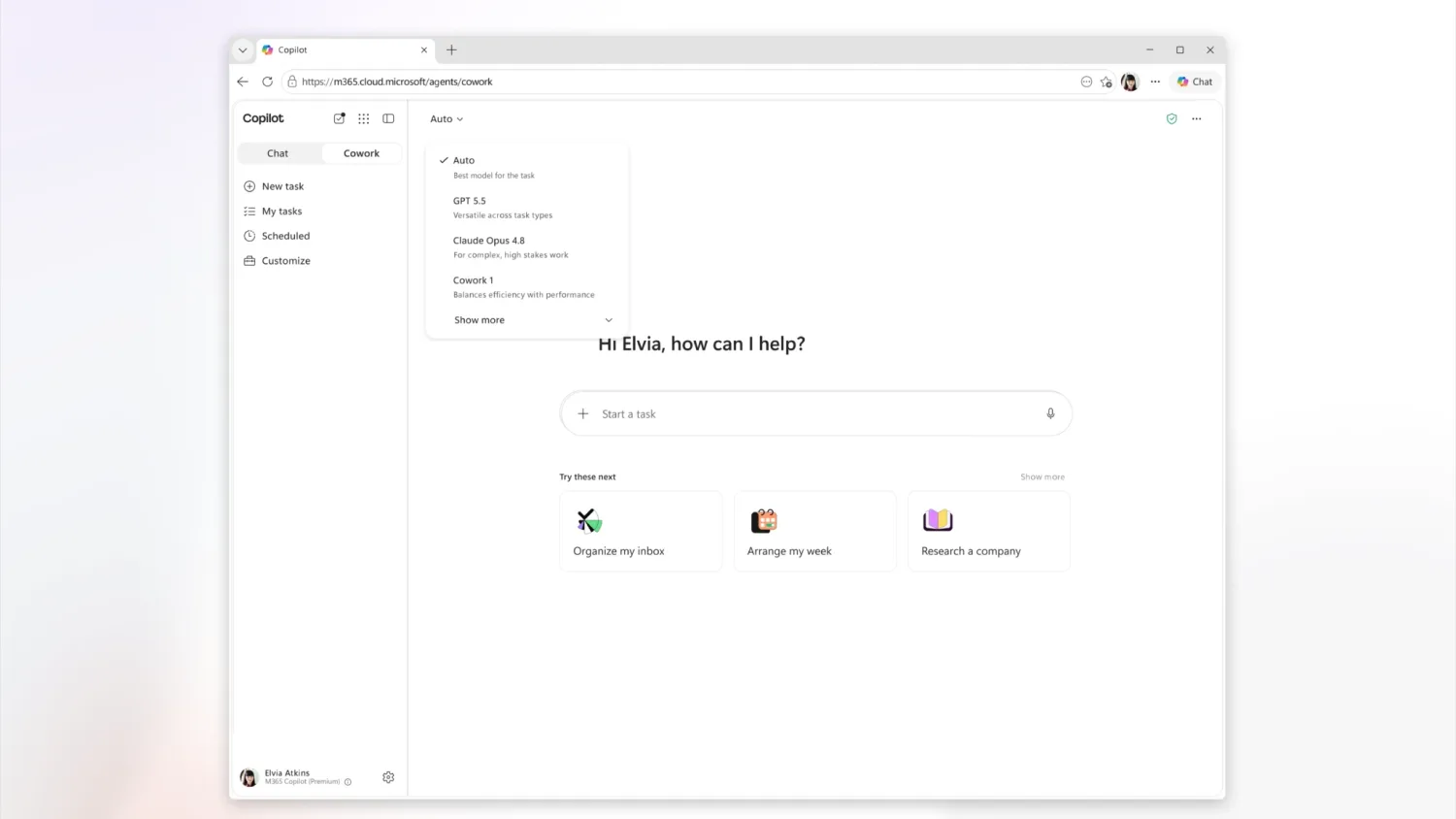
On June 16, 2026, Microsoft made Copilot Cowork generally available worldwide. The announcement, from Charles Lamanna (Microsoft's EVP for Copilot, Agents, and Platform), says more than half of the Fortune 500 used Cowork during its three-month Frontier preview — Accenture, Avanade, Capital Group, Koch, and Zurich Insurance among the named adopters.
The one-line version: Cowork is the part of Microsoft 365 Copilot that does not stop at a draft — it runs the whole task and hands back a finished result. The more interesting story, if you have to budget for and govern this, is the new usage-based billing and a few details the launch post understandably does not dwell on.
What Cowork actually is
Cowork is an agentic system inside Microsoft 365 Copilot. You hand it an objective; it turns that into a plan and executes a complex, long-running, multi-tool task end to end — then returns a completed deliverable rather than a draft or a recommendation. It grounds the work in your organizational context through Work IQ and coordinates across Word, Excel, PowerPoint, Outlook, and Teams.
Out of the box it can draft and send email, schedule meetings, build documents, spreadsheets, decks, and PDFs, post in Teams, search across your organization, and run deeper multi-step research. Because it runs in the cloud, your files stay server-side and tasks keep running even when your laptop is closed. And it is multi-model: a picker lets the system (or the user) choose between Auto, GPT 5.5, Claude Opus 4.8, Sonnet 4.6, and a forthcoming fine-tuned model Microsoft calls Cowork 1.
That last behavior — finishing the task, not just assisting with it — is the real distinction from regular Copilot, which helps you step by step inside a single app.
How it differs from Copilot Studio
Worth clearing up, because the names blur together. Copilot Studio is a low-code platform for building reusable custom agents that can reach systems outside Microsoft 365 (Salesforce, SAP, ServiceNow, your own APIs). Cowork is the thing that executes delegated, multi-step work across the Microsoft 365 apps you already use. Different jobs, not a strict hierarchy — you would still reach for Copilot Studio, or for real deterministic automation, when an agent needs to act on systems beyond the Microsoft 365 boundary.
What is new at general availability
- A Chat / Cowork toggle in the Microsoft 365 Copilot app, so you can move from conversation to delegated work in one place.
- Plugins: nine available now (Enosix, Harvey, LSEG, Miro, monday.com, Moody's, Morningstar, S&P Global Energy, TeamsMaestro) and eight more on the way (Adobe, Atlassian, Box, Canva, CB Insights, Databricks, MoneyForward, Templafy). Fabric and Dynamics 365 connectors reached GA too.
- Browser use (in the Frontier tier) through a local Edge browser, under your existing enterprise policies.
- A security and compliance surface: audit log, Data Security Posture Management, eDiscovery, and Insider Risk Management at GA, with Data Lifecycle Management following on June 22.
- And the part that changes the math for IT: billing.
The real story: usage-based billing
 Source: Microsoft.
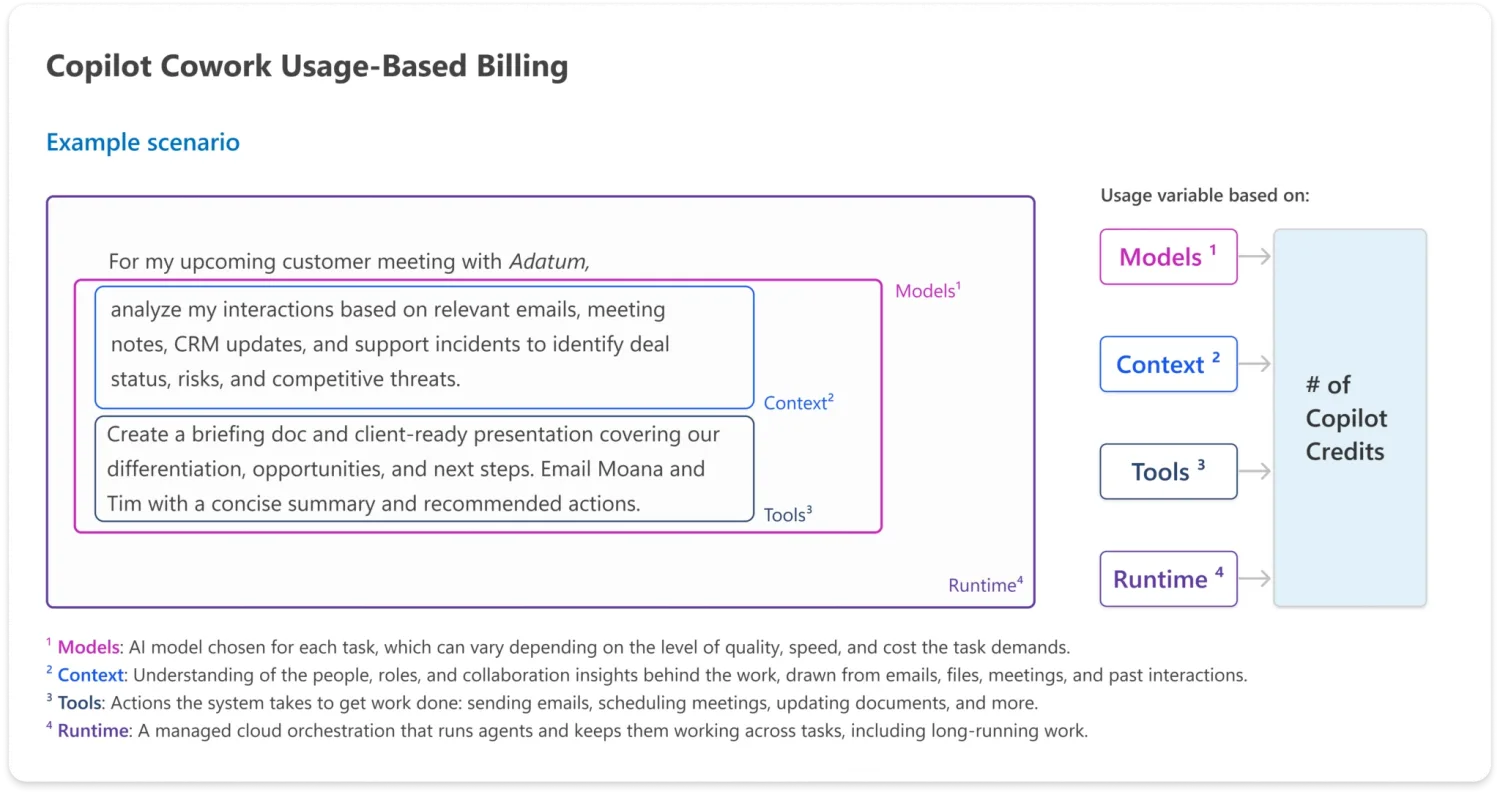
Cowork has no standalone price tag. The entry ticket is the Microsoft 365 Copilot User Subscription License — the familiar 30 USD per user per month enterprise add-on. But access alone does not get you Cowork: usage is then metered separately in Copilot Credits, billed pay-as-you-go at 0.01 USD per credit, or pre-purchased at a discount through a committed-volume plan Microsoft calls P3.
Each task's cost comes from four inputs: model use, context retrieval, tool calls, and runtime. In other words, "included with Microsoft 365 Copilot" does not mean free. The license opens the door; running agents costs more on top, and how much more depends on the task.
 Source: Microsoft.
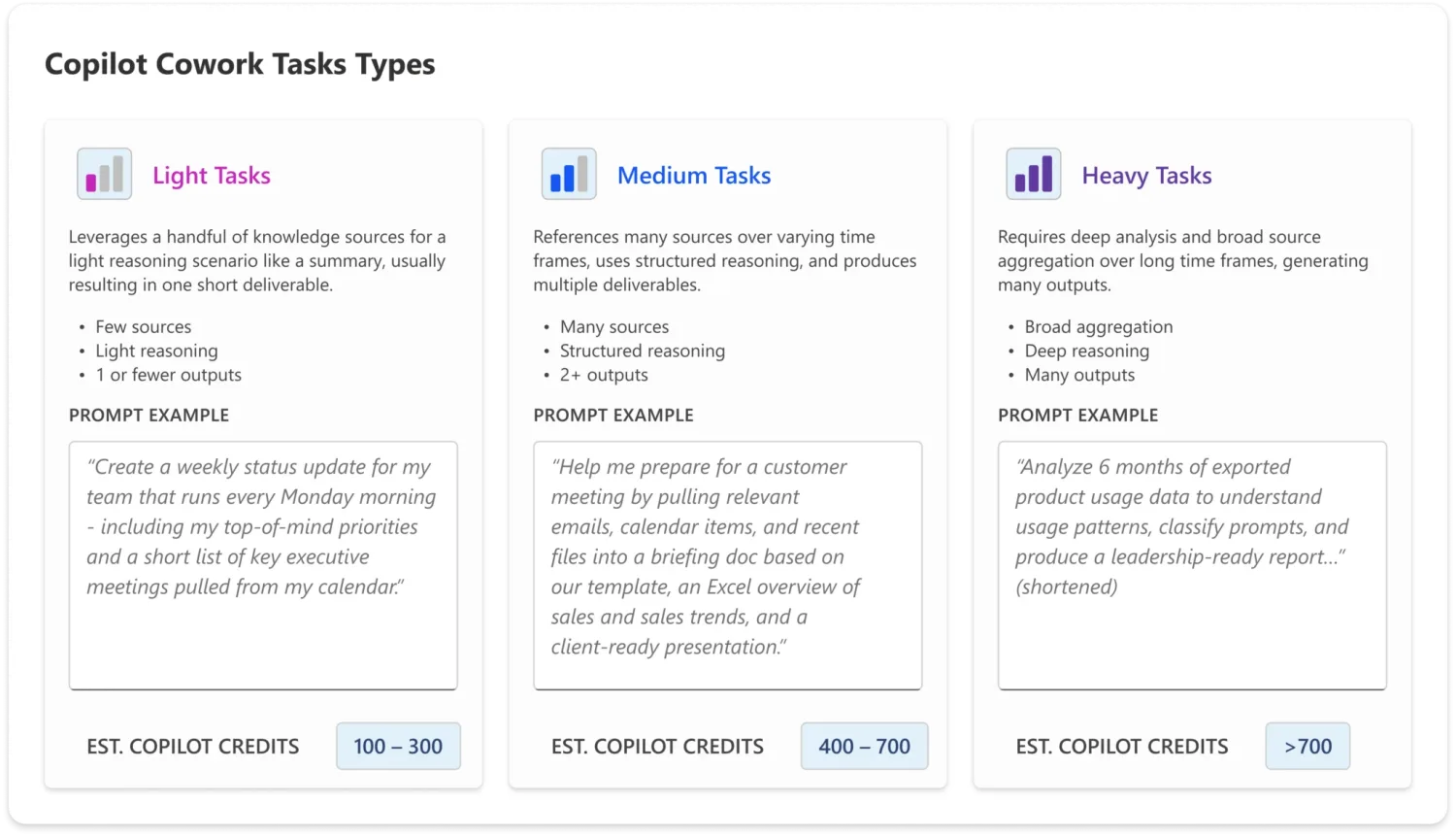
Microsoft's own task tiers give a sense of scale: a light task runs roughly 100 to 300 credits (about 1 to 3 USD), a medium task 400 to 700 (about 4 to 7 USD), and a heavy task more than 700 (7 USD and up). A heavy task — say, "analyze six months of usage data and produce a leadership-ready report" — can cost several dollars each time it runs. Multiply by users and frequency and the monthly number gets blurry quickly.
That unpredictability is the honest catch, and it is worth sitting with: because per-task credit consumption is variable, you cannot easily forecast spend at planning time. Microsoft ships controls to compensate — Cowork is off by default, with spending limits at the tenant, group, and user levels, admin-set usage alerts, per-task usage reporting, and a downloadable Customer Cowork Estimator spreadsheet. Billing started on the GA date, though tenants that had a Frontier user between March 30 and June 16 get a grace period until July 1, 2026.
Microsoft's rationale is reasonable — long-running agentic work genuinely consumes compute. But note the pattern: GitHub Copilot moved to metered billing on June 1, 2026, and that drew a visible backlash from developers. Metered agentic billing is becoming the norm across Microsoft's Copilot line, and it quietly shifts cost risk from Microsoft onto you.
Governance, security, and the EU data-residency catch
Cowork runs inside the Microsoft 365 trust boundary. Prompts, responses, and generated artifacts flow through your existing controls — they are governed, discoverable, and retained — and sensitivity labels are inherited and displayed end to end. The GA security surface covers audit log, DSPM, eDiscovery, and Insider Risk Management.
Two caveats deserve attention. First, Data Loss Prevention is not there at GA — it is listed as "coming soon." For a system that can autonomously email files and post to Teams, DLP not being wired in on day one is a real gap to plan around.
Second, and especially if you operate in Europe: Cowork's multi-model system includes Anthropic's Claude, and Claude models route data outside Azure to Anthropic's infrastructure. They are excluded from the EU Data Boundary and in-country processing commitments. Microsoft enabled Claude by default in commercial tenants back in January 2026 — but left it off by default in the EU, EFTA, and the UK. If you are bound by the EU Data Boundary, confirm which models your Cowork tasks use and keep them on Azure-resident (OpenAI) models.
There is also the obvious agentic risk. A cloud agent with broad file access and the ability to send mail is a natural prompt-injection target; security researchers including Simon Willison have flagged file-exfiltration scenarios for agentic Copilot. Microsoft's off-by-default posture and admin approval gates exist precisely because autonomy plus access equals exposure.
Reliability: design intent vs. guaranteed quality
"Runs end to end and returns a completed result" describes the design, not a guarantee of output quality. Independent practitioner testing suggests Cowork is strongest orchestrating across apps you already have for shorter workflows (roughly 5 to 15 minutes) and degrades on long, complex, build-from-scratch deliverables (the 30 to 60 minute kind) — it is notably weak at, say, producing a proper three-statement financial model unaided. Treat those as practitioner observations rather than benchmarks, but the shape is familiar: agents are excellent glue between systems and less reliable as from-scratch authors.
Who it is for, and a practical take
 Source: Microsoft.
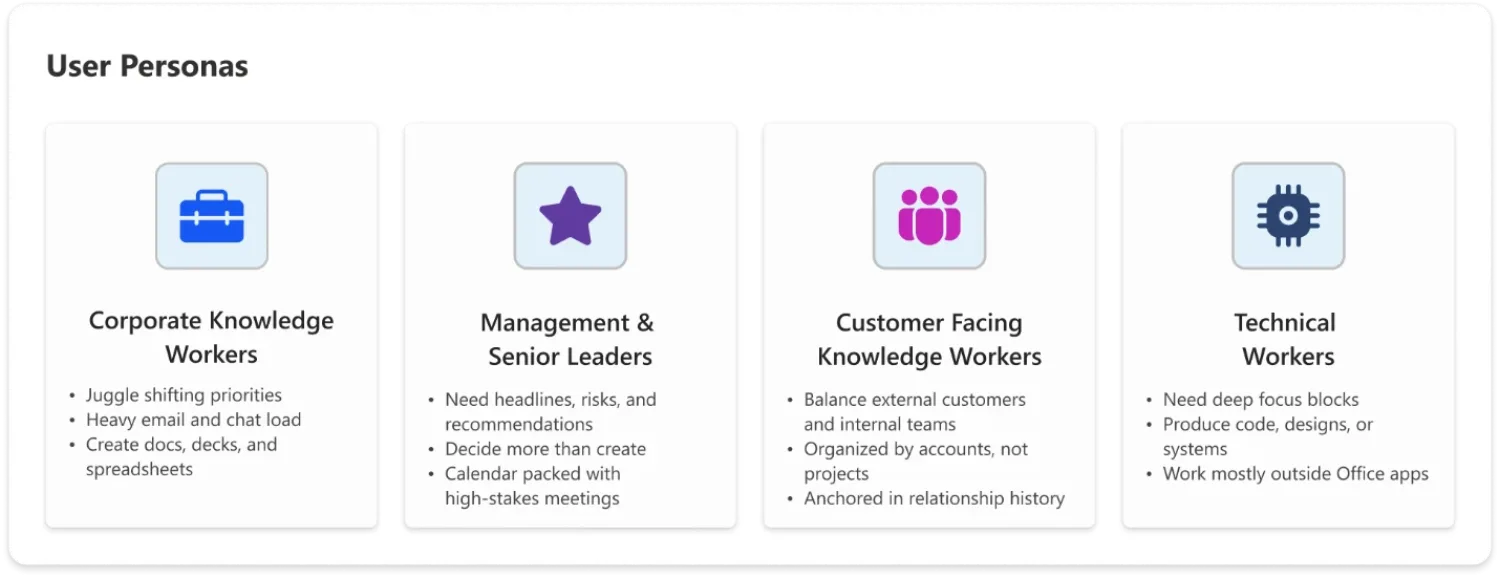
Microsoft frames four personas: corporate knowledge workers, management and senior leaders, customer-facing knowledge workers, and technical workers. Where I would actually point it, as someone who builds automation for a living:
- Lean into cross-app orchestration. The "pull from email, the CRM, and recent files, produce a briefing, and send it" class of task is where Cowork removes genuine work.
- Manage the budget like a cloud bill. Start with a scoped pilot group, set hard spending limits, and watch the per-task reporting before opening it up. Metered agent runtime is easy to underestimate.
- Mind the model and the region if you are under the EU Data Boundary.
- Do not retire deterministic automation. For repeatable, governed pipelines — license cleanup, ticket-driven provisioning, scheduled jobs — purpose-built automation on Azure, Microsoft Graph, and Logic Apps is cheaper and more predictable than paying metered runtime per run. Cowork earns its keep on the ad-hoc, judgment-heavy, cross-system tasks that were never worth automating deterministically.
Cowork is a real step toward agents that finish work instead of just drafting it. Go in with clear eyes on the cost model and the governance, pilot it narrowly, and you will get the upside without the surprise invoice.